A Course in Miracles — Book Summary & Review
Last updated:
A Course in Miracles Summary
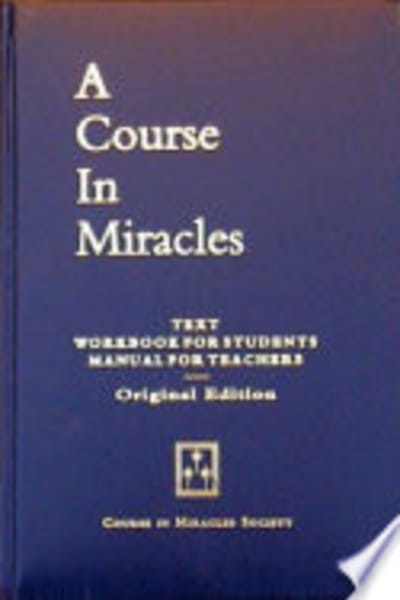
A Course in Miracles is built in three parts—Text, Workbook for Students, and Manual for Teachers—and the whole point is that your mind’s habits, not your circumstances, are the real problem. Schucman’s framework is blunt: the world you perceive is a mental projection, and “miracles” function as a correction in perception, with consequences that show up in how you treat other people. In the Text, you get the metaphysical scaffolding: forgiveness isn’t a sentimental act; it’s the mechanism for undoing the belief that separation is real. Then the Workbook for Students turns that theory into daily practice through 365 specific lessons, and the daily repetition is where this book either works or annoys you. For example, the Workbook’s Lesson “Nothing I see means anything” (and similar exercises) keeps pushing you to stop treating appearances as evidence, then replacing that reflex with a different interpretation. Another concrete example is how the Course frames healing as a shift in how you assign meaning to fear: you’re asked to practice releasing the story you’re telling yourself about danger, then watch how your behavior changes. Schucman also builds a social ethic through the Manual for Teachers—there’s a tone of “teach by your consistency,” not by charisma—so the Course doesn’t let you hide in private spirituality. The honest limitation: this book doesn’t offer an evidence-based psychological or scientific method, and it will frustrate you if you want secular self-help, clear “how-to” for measurable outcomes, or a conventional narrative arc. If you’re willing to do the daily lessons without needing them to justify themselves immediately, Schucman’s system can feel like a full mental reorientation; if you’re not, A Course in Miracles will feel like homework that never ends.
Key Takeaways from A Course in Miracles
-
1
Text framework: Separation is treated as a mistaken belief, not a factual condition, so your “real work” is correcting perception.
-
2
Workbook lessons: The 365 daily Lesson structure trains attention by repeating specific thought reversals until reflexes change.
-
3
Forgiveness mechanism: Forgiveness is defined as letting go of the meaning you assigned to harm, not performing emotional theater.
-
4
Miracles as perception shift: Miracles are described as altered seeing that then affects behavior, relationships, and the world you experience.
-
5
Manual for Teachers: Teaching is portrayed as consistent practice rather than authority, making “spiritual status” irrelevant.
Who Should Read This
Someone who feels stuck in a loop of resentment, fear, or blame and keeps trying to fix it with willpower will likely benefit from the Workbook’s daily re-training. If you’re willing to treat your thoughts as the main cause of your suffering, Schucman’s approach gives you a structured way to practice that belief.
Who Shouldn't Read This
If you want a secular, research-backed self-help program with measurable milestones, Schucman’s metaphysical claims will feel like dead weight. If you hate repetitive daily exercises and need a conventional narrative to stay engaged, the 365-lesson format will frustrate you fast.
Editor's Verdict
The best thing A Course in Miracles does is make its metaphysics livable through the Workbook’s daily Lesson design—“Nothing I see means anything” is the kind of instruction that forces you to test your own mental reflexes. The limitation is structural and ideological: it offers no conventional psychological science, no practical troubleshooting for specific diagnoses, and it expects you to accept its metaphysical premise to get traction. This hits hardest for someone newly exhausted by therapy-speak and productivity advice, who wants a single, total framework to practice every day instead of more information.
Ready to read A Course in Miracles?
Get your copy on Amazon today.
A Course in Miracles — Frequently Asked Questions
About Helen Schucman, Scribe
Helen Schucman (1909–1981) was an American psychologist and researcher who worked at Columbia University Medical Center. She is best known as the “Scribe” for A Course in Miracles, a spiritual text she reported receiving through a process of inner dictation. Her credibility on the topic is grounded in her professional background in psychology and her role as the documented transcriber of the Course’s material. She also authored related writings such as The Gifts of God and the journal compilation Seeds of Heaven.